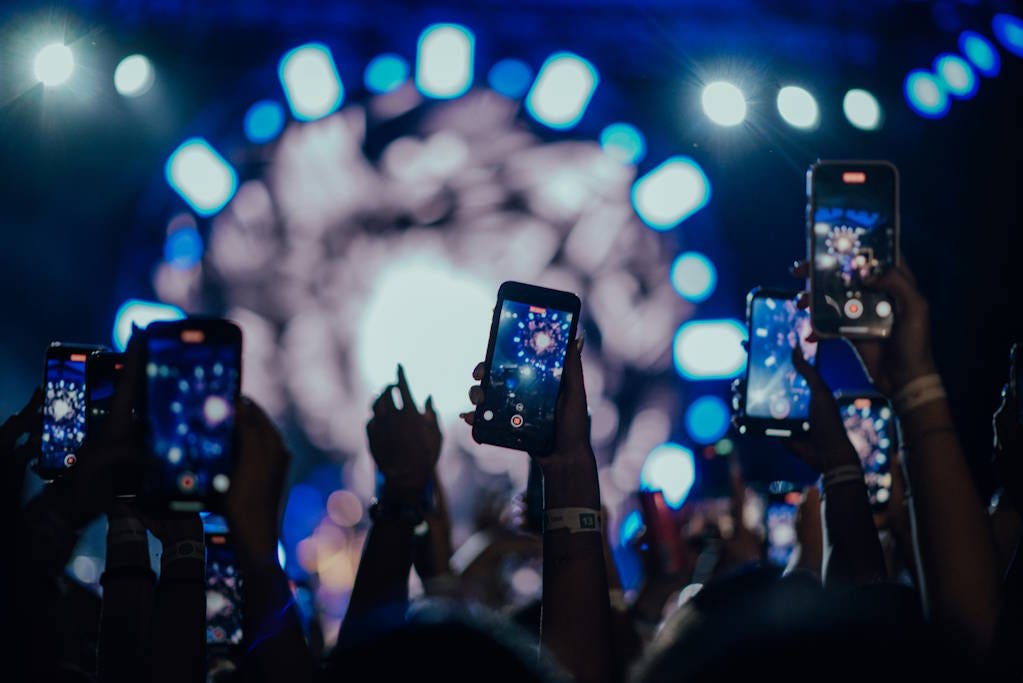
Are you finally ready to admit it's the phones?We didn't evolve to live our lives as terminals of a digital hive-mind.
“No. I am Hugh.” — Hugh I remember the first time I heard about the invention of the iPhone, back in 2007. My friend, who followed Apple products with an almost religious zeal — there were many such people in those days — entered the room and announced “This is the convergence!” We spent the next few minutes gaping in awe at the idea that every single piece of portable consumer electronics was about to be combined into a single device. For many, it felt like a messianic moment. The iPhone was probably the last big innovation that we Americans embraced as a whole society. Everybody had an iPhone, or wanted one. Engineers loved how the thing was engineered. Humanities PhD students showed off the latest model at parties and admired the sleek design.¹ Kids in working class neighborhoods were glued to their iPhones in math class. It was a supercomputer in your pocket, a voice for the voiceless, the tricorder and the communicator from Star Trek, all that and more. It was also big money. Years before Benedict Evans wrote “The smartphone is the new sun”, every ambitious tech entrepreneur and content creator in America was in on the game. Social media — that infinitely scrolling vertical feed — was the killer app of the smartphone, what the spreadsheet had been for the PC or e-commerce had been for the internet. In 2012, Facebook’s monster IPO kicked off a gold rush, and everyone moved to San Francisco to strike it rich. But you didn’t need to be a tech entrepreneur in order to get in on the action. The smartphone meant far more eyeballs glued to far more screens for far more minutes of the day, and that meant dollar signs for content creators. YouTubers, Instagram fashion influencers, and Twitter activists became whole new economic classes. Old-style content businesses like newspapers and TV networks saw their doom, but also a potential lifeline. (Eventually even econ bloggers got our piece of the pie; plenty of you signed up for this blog through a scrollable app.) Beautiful design coupled with brilliant engineering. Technology anyone could use. Economic opportunity for the masses and for the elite. A way to have your ideas and opinions heard by millions of people thousands of miles away, at any hour of any day. No wonder Steve Jobs was the last technologist that everyone agreed was an American hero. But when I recall that fateful day in 2007, I remember not joy, but a sudden surge of foreboding. That was strange, and out of character for me. I’ve always been a technophile at heart — I grew up as a hardcore Star Trek fan, and until that moment in 2007, each new marvel — broadband, the internet, the laptop computer, etc. — had felt like it was moving us toward that bold utopian future. The iPhone felt different. Some small voice in the back of my head told me: “This is a mistake.” And though I tried to ignore that voice for many years, it remained. What was I worried about? I think some part of me knew that someday, I would end up saying something like this:
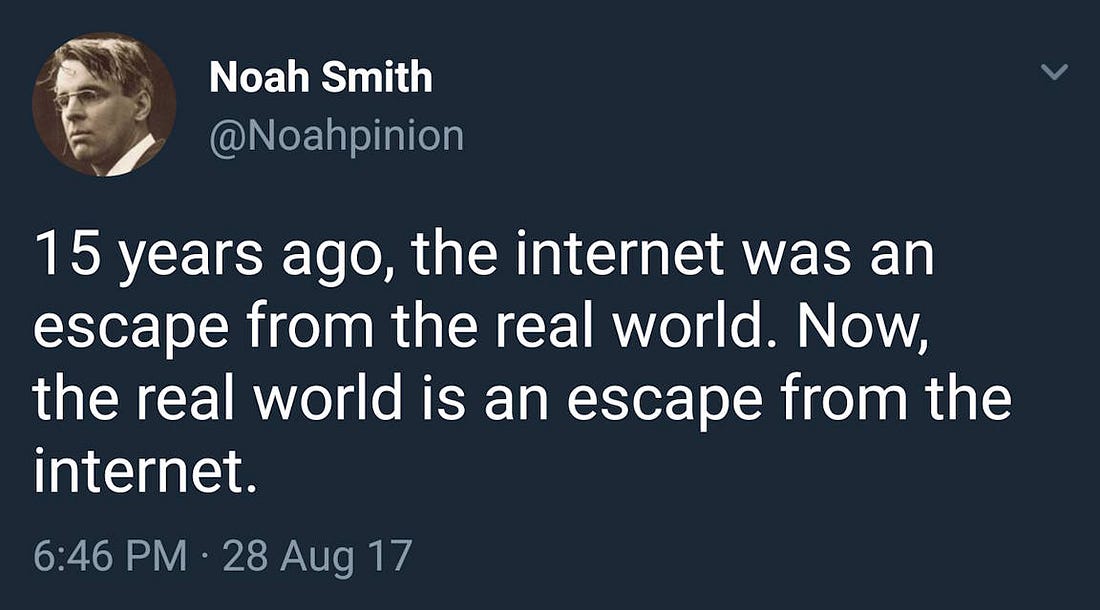
The internet was wonderful because it was a place you could go — a complement to real life, not a substitute. The iPhone promised to put that fantasy universe in our pockets 24/7, and we would never escape. It would be physically possible to turn off our phones, of course, but it wouldn’t be socially possible — you could always touch grass, but after everyone had an iPhone, that would be the only conduit through which you could touch another human mind. The idea of perpetually tying every human into a global hive mind tripped alarm bells. It reminded me too much of the hive minds I had seen depicted in science fiction nightmares — the Borg from Star Trek, the Blight from A Fire Upon the Deep, the Human Instrumentality Project from Neon Genesis Evangelion. Humans were meant to be individuals — unique, independent incubators of ideas and desires, not terminals or the fingers of a world-mind. We had spent centuries trying to escape the small, localized versions of the hive mind. The printing press, the car and the telephone had offered freedom from the crushing conformity of small-town life. When broadcast television threatened to smother us with a centrally dictated monoculture, it sparked a decades-long resistance. When the internet arrived, we spent two decades using it to revel in our individuality — we made our personal websites, started blogs, joined small online communities centered around our interests. Sometime around 2014 or 2015 we woke up to the fact that the world of the Old Internet no longer existed. “The internet” no longer meant the Web — it meant a tiny handful of big platforms. Twitter and Reddit for screaming about politics, Facebook and Instagram for being jealous of your friends’ vacation pics. Gone were the days of painting our individuality on the canvas of the Web. The platforms were the hive minds, we were the neurons, and the smartphone was the axon that kept each of us wired tight into the collective. “‘Social media is bad,’ he typed on social media!!” This is the perpetual and instantaneous response of many of the neurons…er, people…in my timeline. Indeed, if social media is so bad, why don’t you just put down the phone? But this idea displays a fundamental misunderstanding of the nature of network effects. Suppose I decide to get off Instagram and go play pickup basketball instead. If everyone else is on Instagram instead of playing pickup basketball, who am I going to play with? This is an extreme and simplified example, obviously, but the intuition here comes from real research. Bursztyn et al. (2024) have a paper called “When Product Markets Become Collective Traps: The Case of Social Media”. Here’s a quick summary:
The students said that they only stayed on TikTok because other people were on it too, and they were afraid of missing out. FOMO is not utility; it’s a bad equilibrium. There’s also an impulse to do a sort of “Good Tsar, bad boyars” maneuver, where people say “it’s not the phones, it’s social media”. But this is an argument over whether guns kill people or bullets kill people. Yes, we could access social media from laptops or other stationary devices, but we could only do so for part of the day; that would force us to develop offline interactions and relationships during the other hours, like we did back in 2007. It’s the ever-present umbilical that enables — and perhaps even mandates — the replacement of in-person interaction with an online hive mind.² In 2007 I suppressed my deep-seated doubts about smartphone technology. I am a techno-optimist, and this was just another miraculous new tool for human empowerment. And yet the two decades since 2007 seem to have only validated my misgivings, across a number of dimensions. Plenty of evidence has linked smartphones — and the social media apps that take up the single biggest chunk of the time we spend on those phones — to rising unhappiness among the world’s young people:
Since I wrote about this in 2023, the evidence has only grown stronger. Here’s an experiment by Castelo et al. (2025):
Other recent experiments have yielded similar results. The likeliest explanation is that there is simply something thin and insufficient about online interaction. It’s lacking in some essential emotional nutrient that human beings evolved to harvest from the physical proximity of other human beings. Perhaps it’s something cognitive — the richness of context that tells you that no, your friend’s life isn’t perfect just because they posted a cool video of their trip to Europe, and thus you don’t need to feel constantly envious and inadequate and left-out. Or perhaps it’s something physical — the tiny touch of a high-five or a hug, the simple feeling of the proximity of other human bodies. Whatever this emotional nutrient is, our young people are starving for it, while they binge on the cheap sugar-alcohol of emoji reactions and story views. In other parts of the world, young people are just starting to break free of this collective trap, but not yet in the United States. But making teenagers sad is one thing; putting an end to the Human Age on planet Earth is quite another. The global fertility decline is a long-standing trend. Every country that escapes poverty, urbanizes, and teaches its people to read is going to transition from a high fertility rate (5-7 children per woman) to a much lower rate. Long before the smartphone burst on the scene, most of Europe and the richer parts of East Asia had fallen below replacement-level fertility. Everyone would crack jokes about Japan not having enough kids. ... Keep reading with a 7-day free trialSubscribe to Noahpinion to keep reading this post and get 7 days of free access to the full post archives. A subscription gets you:
|